

From images to insight: AI builds the first pediatric reference map for meibomian glands
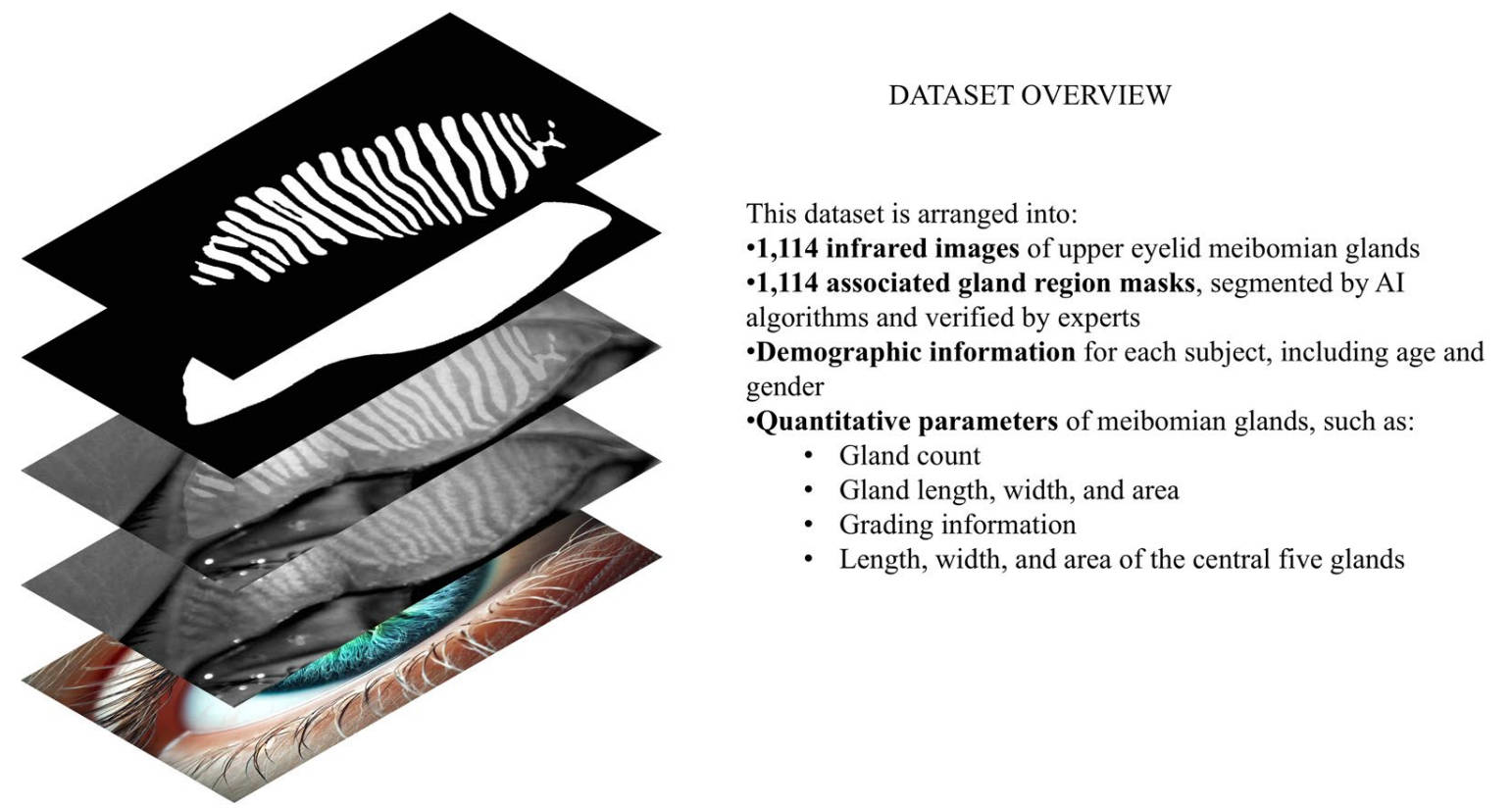
Overview of the Children and Adolescents Meibomian Gland (CAMG) dataset.
GA, UNITED STATES, February 15, 2026 /EINPresswire.com/ -- Artificial intelligence (AI) is increasingly reshaping medical imaging, yet its progress depends heavily on the availability of reliable, well-curated data. In eye health, the lack of standardized quantitative reference data for children and adolescents has long limited objective assessment of meibomian glands—structures essential for maintaining a stable tear film. This study introduces a large, quality-controlled dataset that combines infrared eyelid imaging with AI-assisted segmentation to quantify gland morphology across pediatric age groups. By establishing age- and sex-stratified benchmarks, the research provides a foundation for objective evaluation, early detection of gland abnormalities, and the development of AI tools tailored to younger populations.
Dry eye disease is a common ocular condition that can significantly impair quality of life, and dysfunction of the meibomian glands is a major contributing factor. Advances in infrared meibography allow clinicians to visualize these glands, but interpretation remains highly subjective and varies between observers. While artificial intelligence (AI) offers powerful tools for automating image analysis, its clinical reliability depends on high-quality training datasets. This challenge is particularly acute in pediatric populations, where imaging is more difficult and normative data are scarce. Based on these challenges, there is a clear need to establish a rigorously curated, quantitative reference dataset to support standardized and AI-driven analysis of meibomian gland development in children and adolescents.
Researchers from institutions including The University of Melbourne and Fujian Medical University reported (DOI: 10.1186/s40662-025-00460-2) on November 6, 2025, in the journal Eye and Vision, the creation of the Children and Adolescents Meibomian Gland (CAMG) dataset. The study presents a large open-access collection of high-quality infrared images of upper eyelid meibomian glands, analyzed using AI. By combining multi-stage expert quality control with deep-learning segmentation, the team generated reliable quantitative measurements of gland morphology across a wide pediatric age range.
The CAMG dataset comprises 1,114 quality-controlled infrared images collected from 730 children and adolescents aged 4–18 years. Each image underwent rigorous preprocessing and multi-level expert screening before being analyzed by an AI model based on a U-Net architecture. This approach enabled precise segmentation of meibomian glands and extraction of key morphological parameters, including gland length, width, area, gland count, and gland dropout ratio.
The AI model achieved high performance, with an accuracy exceeding 97% and strong agreement with expert annotations, demonstrating its suitability for automated gland analysis. Quantitative results revealed that major gland parameters remained remarkably stable across childhood and adolescence, suggesting that meibomian gland morphology reaches a developmental plateau early in life. Subtle but consistent sex-related differences were observed: females tended to have slightly wider and larger glands, whereas males showed a higher number of glands overall.
Importantly, the study focused on upper eyelid glands, which account for the majority of meibomian tissue and show stronger associations with dry eye symptoms. By providing transparent documentation of image acquisition, quality control, and annotation procedures, the dataset addresses a major limitation of earlier studies and offers a reproducible benchmark for future AI development and epidemiological research.
“Reliable AI in medicine starts with reliable data,” said one of the study's senior investigators. “For pediatric eye health, we have lacked standardized reference values for normal gland development. This dataset fills that gap by combining strict quality control with quantitative analysis. It allows researchers and clinicians to distinguish between normal developmental variation and early signs of dysfunction, which is essential for both clinical decision-making and the next generation of AI diagnostic tools.”
The CAMG dataset provides a critical foundation for precision diagnostics in pediatric ophthalmology. By offering age- and sex-specific reference values, it enables earlier identification of abnormal gland development that may predispose children to dry eye disease later in life. Beyond clinical use, the open-access nature of the dataset supports global collaboration, algorithm benchmarking, and transparent AI validation. It may also facilitate future studies on environmental and lifestyle factors—such as screen exposure—that increasingly affect children's eye health. Ultimately, this work demonstrates how carefully curated data can transform AI from a promising technology into a dependable clinical partner.
DOI
10.1186/s40662-025-00460-2
Original Souce URL
https://doi.org/10.1186/s40662-025-00460-2
Funding information
The work was supported by Natural Science Foundation of Fujian Province, China (Grant No. 2024J011019) to LL.
Lucy Wang
BioDesign Research
email us here
Legal Disclaimer:
EIN Presswire provides this news content "as is" without warranty of any kind. We do not accept any responsibility or liability for the accuracy, content, images, videos, licenses, completeness, legality, or reliability of the information contained in this article. If you have any complaints or copyright issues related to this article, kindly contact the author above.
